What is the broken bone theory. Lets Uncover Reality.
A clear, honest, and evidence-balanced guide to understanding the broken bone theory — what it means, where it came from, what science says, and how to use it wisely.
Introduction to the Broken Bone Theory
Have you ever noticed that some people go their entire lives without breaking a single bone, yet seem to carry a heavy weight of emotional pain? Meanwhile, others snap a wrist falling off a bike, then lead what looks like a fairly smooth emotional life?
The broken bone theory is a popular idea that tries to explain this pattern. At its core, it suggests a kind of invisible balance between the physical body and the inner emotional or spiritual self. If your body stays unbroken, the theory says, your inner world might absorb more of life’s hardships instead.
It is not a medical diagnosis or a proven scientific law. But for millions of people, it captures something that feels deeply true about their experience — and that emotional truth is worth taking seriously and exploring honestly.
Core Premise and Common Phrasings of the Broken Bone Theory
The broken bone theory comes in several versions, but they all share the same underlying idea: pain finds a way in. Whether it enters through the body or through the emotions and spirit, it does not simply skip a person.
“Body spared = soul fractures instead”
This version says that if your bones never break, your emotional life may carry more breaks instead. The person who never snapped a collarbone might have grown up navigating anxiety, grief, loss, or trauma that left deep invisible marks. The body stayed whole; the inner life took the hits.
This resonates with many people because invisible pain is often the hardest kind. There are no casts, no X-rays, no visible proof that something was broken. Yet the hurt is very real.
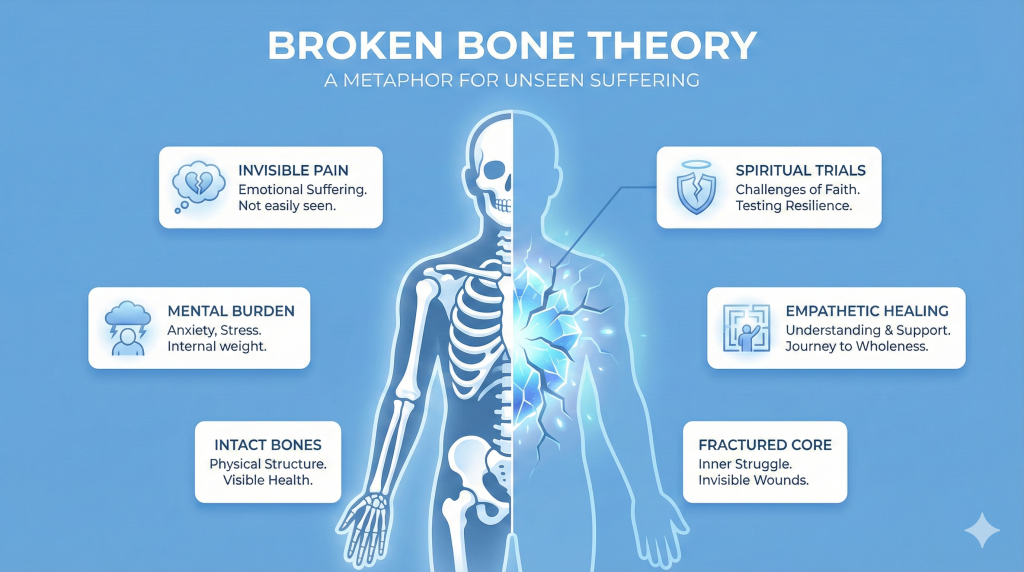
“Never broken a bone = chosen for deeper emotional or spiritual trials”
This version frames unbroken bones as a kind of signal. The person has been protected physically because life has bigger tests in store for their mind and spirit. Rather than feeling lucky, they are seen as carrying a heavier and more meaningful burden.
Whether you believe this literally or take it as a metaphor for how some people are given unusually hard emotional paths, the idea offers a way to make meaning out of suffering that has no obvious cause.
Why the Broken Bone Theory Feels True to Millions
The theory resonates so widely for several reasons that have nothing to do with whether it is literally true.
First, it validates invisible suffering. Many people live with anxiety, depression, trauma, grief, or chronic emotional pain that others cannot see. Being told “your suffering is real, it just looks different” is genuinely comforting.
Second, humans are pattern-seekers by nature. When an idea seems to fit our experience — even loosely — our minds latch onto it and look for confirmation. The broken bone theory is flexible enough that most people can find a way it applies to them.
Third, there is a dark humour angle. People joke about wanting to finally break something just to “balance the scales.” This kind of humour is a real and healthy coping mechanism for people dealing with ongoing pain.
Finally, it speaks to the desire for life to have meaning. If your suffering has a reason — even a mysterious or spiritual one — it is easier to bear than suffering that seems random and pointless.
Origins and Evolution of the Broken Bone Theory — A Verified Timeline
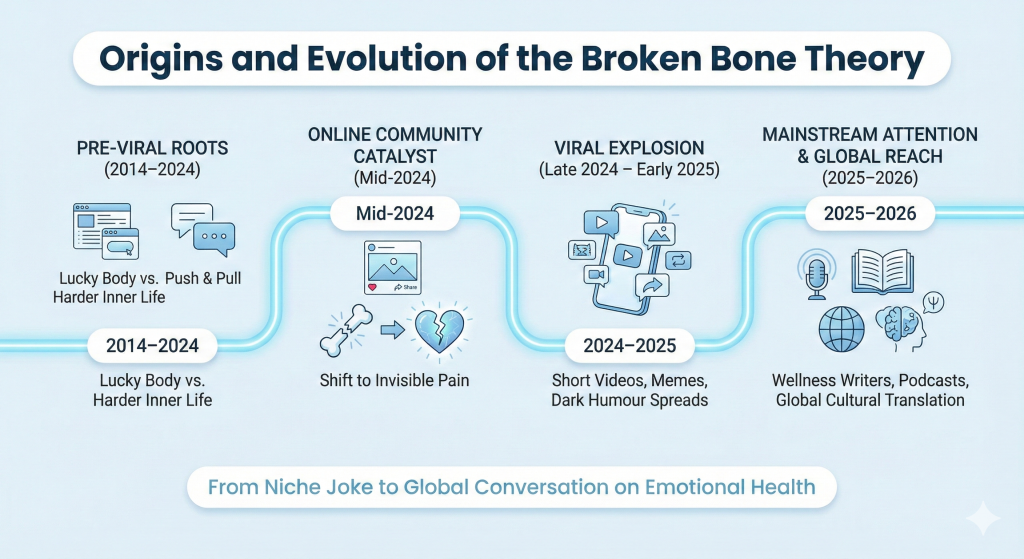
The broken bone theory did not appear overnight. It grew gradually through online communities before exploding into mainstream conversation.
Pre-Viral Roots (2014–2024)
Long before the theory had a name, people in online communities were already joking about physical invincibility and emotional fragility. Forum threads would celebrate “never broken a bone” as a point of pride — a sign of good luck, careful living, or sturdy genetics.
At the same time, a counter-narrative existed: gentle teasing that the physically lucky ones were paying somewhere else. This push and pull between celebration and soft roast laid the foundation for what would come later. Two competing ideas were already circling each other — “lucky body” versus “harder inner life.”
Online Community Catalyst (Mid-2024)
Around mid-2024, posts on social media began framing “never broken a bone” not as good luck but as a signal of hidden hardship. The framing shifted: unbroken bones were no longer just a physical fact but a shorthand for “I carry pain you cannot see.”
These early posts connected with people who felt their suffering was invisible or dismissed. They shared, commented, and added their own stories. A simple observation about bone health became a shared language for talking about invisible pain.
Viral Explosion (Late 2024 – Early 2025)
By late 2024, the idea had the ingredients for rapid spread: short video formats, emotional resonance, and a strong community of people who felt seen by it. Creators made “POV: you’ve never broken a bone” sketches. Others made duet videos reacting to the idea with their own stories. Meme edits gave it a humorous, shareable quality.
The combination of emotional depth and dark humour made it spread across age groups and countries. People were not just sharing a meme — they were using it to process real feelings.
Mainstream Attention and Global Reach (2025–2026)
By 2025, the broken bone theory had moved well beyond social media. Wellness writers picked it up. Podcasters discussed it in long-form episodes about emotional health and invisible suffering. Mental health professionals began referencing it — sometimes critically, sometimes as a way to open conversations about pain that people struggle to name.
Globally, the core idea translated across cultures even when the specific framing varied. The universal thread was the same: the body and the inner self are connected, and pain takes many different forms.
Spiritual, Religious, and Metaphysical Interpretations of the Broken Bone Theory
For many people, the broken bone theory is not just a social media trend — it connects to deeply held spiritual or religious beliefs. Here are the main frameworks through which people interpret it.
Biblical Foundation
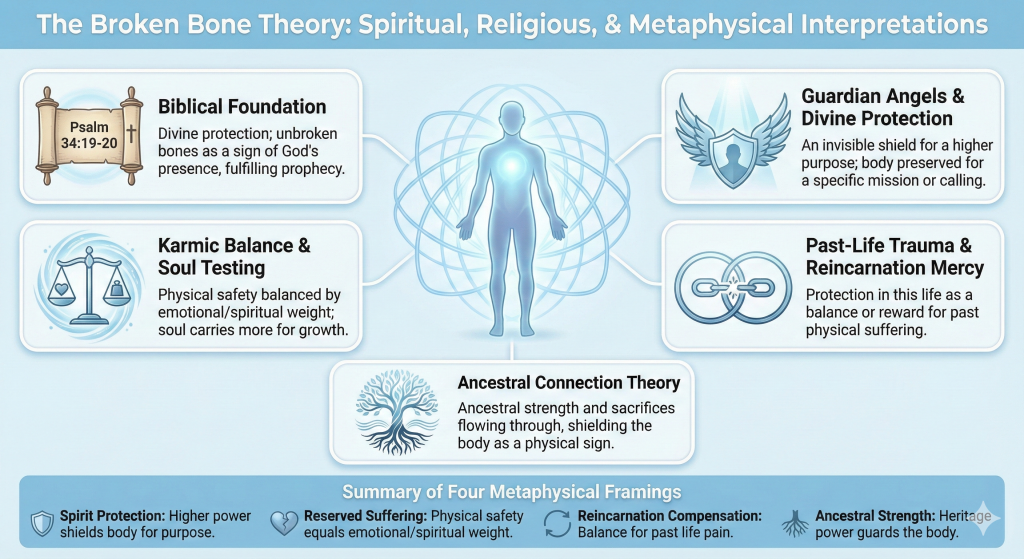
One of the most commonly cited texts is Psalm 34:19-20, which speaks of God protecting the bones of the righteous so that not one is broken. In Christian tradition, this verse is also understood as pointing to the suffering of Jesus, whose bones were not broken during the crucifixion — fulfilling a prophetic promise about the Messiah.
People who take a spiritual view of the broken bone theory sometimes read this literally: unbroken bones are a sign of divine protection. Others read it more poetically, understanding it as comfort that God is present and attentive even in the middle of great suffering.
It is worth being careful here. Using a comfort verse as a personal fortune-telling system — “my bones are intact, therefore I am spiritually chosen” — is a very different use than the original intent of the text, which was to offer hope to people already in pain.
Guardian Angels and Divine Protection
A related idea is that some people have an invisible shield around them — guardian angels or a higher power that keeps their physical body whole. The reason, in this view, is not luck but purpose: the person has a mission or calling that requires their body to remain intact.
This framing gives meaning to physical safety while simultaneously explaining why life still feels hard. The body is preserved; the spirit is being shaped through challenges.
Karmic Balance and Soul Testing
In traditions that include ideas of karma, everything is eventually balanced. If physical hardship is removed from your life, the load does not disappear — it shifts to the emotional and spiritual level. Your soul carries more weight to compensate.
This idea is not unique to the broken bone theory. Many spiritual traditions hold that difficulty is part of growth, and that avoiding one kind of trial does not mean escaping trials altogether — it may mean facing a different, deeper kind.
Past-Life Trauma and Reincarnation Mercy
Some people who believe in reincarnation interpret unbroken bones as a form of mercy carried across lifetimes. If the soul endured great physical suffering in a previous life, perhaps this life offers protection from physical pain as a kind of balance or reward — while the emotional and spiritual growth continues through other means.
Ancestral Connection Theory
Another interpretation connects bone strength to ancestral lineage. In this view, the strength and protection of your ancestors flows through you, shielding your body as a result of their sacrifices, prayers, or spiritual power. Unbroken bones are a physical sign of a spiritually strong family line.
A Summary of the Four Main Metaphysical Framings
Across these different traditions, four core ideas appear most often:
Each of these offers a way to make sense of why some people seem physically fortunate yet emotionally burdened. None of them is provable in a scientific sense, but for many people they provide real comfort and a meaningful framework for understanding their lives.
Psychological Appeal and Cultural Resonance of the Broken Bone Theory
The broken bone theory did not go viral by accident. It spread because it spoke directly to something millions of people quietly feel but rarely hear put into words that their suffering is real even when nobody can see it. There are no X-rays for grief, no casts for anxiety, no visible proof that a person has been through something hard.
For people carrying that kind of invisible weight, a simple idea that says “your body was spared, but your soul took the hits” can feel like the first honest description of their life they have ever encountered. On top of that, humans are natural pattern-seekers. We look for meaning in our experiences, especially the painful ones.
When an idea fits even loosely the mind holds onto it. The broken bone theory is flexible enough to fit almost anyone’s story, which is part of why it feels so universally true. Add in a layer of dark humour and a quiet sense of being “chosen for something harder,” and you have all the ingredients for an idea that does not just spread it sticks.
Why the Broken Bone Theory Resonates So Deeply
Beyond spirituality, the broken bone theory works on a deep psychological level. Understanding why can actually help you use it more wisely.
We are wired to look for patterns and meaning. When something happens to us — especially something painful — our minds search for an explanation. The broken bone theory offers one: your suffering is not random, it is purposeful. That shift from “meaningless pain” to “meaningful trial” can be genuinely therapeutic.
It also validates people whose struggles are invisible. Mental health struggles, emotional pain from loss, childhood trauma, relationship wounds — these leave no physical marks. The broken bone theory says: your invisible scars count. That validation matters enormously to people who have spent years feeling that their suffering is not real or not serious because they cannot point to a physical cause.
The “chosen one” element — the idea that you are singled out for deeper trials — can feel empowering rather than victimising. It reframes hardship as meaning rather than misfortune. For some people, this shift in perspective genuinely helps them cope.
Real-Life Testimonials and the Stories People Share
When the theory went viral, comment sections filled with paired stories that felt almost eerie in their consistency. One person would write: “Never broken a bone. Grew up in a chaotic home, struggled with anxiety my whole life, lost people I loved early.” Another would respond: “Same. No fractures, but I feel like my soul has been broken a dozen times.”
Brothers and sisters told contrasting stories: the sibling who broke bones multiple times living what seemed like an easier emotional life, while the unbroken sibling carried depression or loss. These anecdotes are not scientific evidence — but they are real human experiences that deserve to be taken seriously as personal meaning-making.
The Psychological Mechanisms at Work
It is also worth understanding the mental processes that make the theory feel so convincing, because awareness of these can prevent the idea from becoming harmful.
Confirmation bias is the tendency to notice and remember the evidence that supports what we already believe, while overlooking the evidence that doesn’t. If you believe the broken bone theory, you will likely notice and share stories that confirm it — and forget the many cases where someone has never broken a bone and also had a relatively easy emotional life.
Survivorship bias means we mainly hear from people whose experience fits the pattern. The many people for whom the theory doesn’t apply are less likely to speak up, so the stories we hear feel more consistent than reality actually is.
Spiritual bypassing is a psychological term for using spiritual ideas to avoid dealing with real issues. If someone believes “this pain is just my spiritual path,” they may not seek therapy, medical help, or make practical changes that could genuinely improve their life. The theory can become a way of accepting suffering rather than addressing it.
Scientific Reality and Medical Facts — An Evidence-Based Perspective
The broken bone theory is a meaningful metaphor for many people — but it is important to also understand what science actually tells us about who breaks bones and why. This knowledge does not cancel out the emotional truth of the theory; it adds an important layer of understanding.
What Actually Determines Fracture Risk
Your bone health and your likelihood of suffering a fracture are shaped by a combination of factors that are very well understood by medical science. None of them are spiritual or metaphysical.
Genetics play the largest role. Your DNA determines your bone density, the quality of your collagen (the protein that gives bones flexibility), and the peak bone mass you reach in early adulthood. Some people are simply born with stronger bones, just as some are born with better eyesight or faster metabolisms.
Nutrition is critical. Calcium and vitamin D are the building blocks of bone. People who grow up with diets rich in these nutrients build stronger, denser bones that are more resistant to fractures throughout life.
Exercise, particularly weight-bearing and strength exercise like walking, running, or lifting, stimulates bones to grow stronger. People who are physically active tend to have denser, more resilient bones.
Hormones and age also matter significantly. Bone density changes across life — it peaks in your late 20s and gradually declines, more rapidly for women after menopause and for men as testosterone levels drop. This is why fracture rates increase with age.
Lifestyle choices round out the picture. Smoking, heavy alcohol use, and a sedentary lifestyle all weaken bones. Risk-taking behaviour increases exposure to falls and impacts. Safe environments reduce it.
How Common Is “Never Broken a Bone”?
The reality is that a large number of people go through life without any significant bone fracture. This is not miraculous or spiritually significant — it is the expected outcome for people who have good genetic bone density, reasonably good nutrition, and lives that do not involve high-impact physical risk.
Fracture rates increase significantly in older age, particularly after 65, when falls and fragility fractures (breaks from relatively minor impacts) become more common. But many people with good bone health and lower fall risk still avoid fractures well into old age.
If you have never broken a bone, the most likely explanation is simply that you inherited good bone density and have lived in ways that support bone health — not that you are carrying an invisible spiritual burden.
The Mental Health and Bone Health Link — A Surprising Counter-Narrative
Here is something genuinely interesting that science reveals, and which actually turns the broken bone theory on its head in a fascinating way.
Research shows that chronic stress, depression, and trauma can actually increase fracture risk. This happens through several pathways. Chronic stress raises cortisol levels, and prolonged high cortisol weakens bone by reducing bone density over time. Depression is associated with lower levels of physical activity, poorer nutrition, and sometimes higher rates of falls. Difficult childhoods marked by adversity can interfere with bone development during critical growth years.
In other words, the people the theory describes as having “soul fractures” may also be at higher risk for actual bone fractures — not lower risk. The idea that emotional suffering and physical safety are traded off against each other is not supported by the evidence. They can actually move together.
What Doctors Say
Medical professionals who have engaged with the broken bone theory are clear: bone fracture history is explained by genetics, nutrition, exercise, hormones, and chance. There is no evidence that unbroken bones indicate spiritual protection, reserved suffering, or metaphysical balance.
That said, thoughtful clinicians also recognise the importance of the emotional truth the theory speaks to. People’s need to make meaning from their suffering is real and valid. The goal is not to dismiss that need but to ensure people also access real help — whether medical care for bone health or mental health support for emotional pain — rather than substituting a spiritual narrative for practical action.
Criticisms, Logical Flaws, and Potential Harm of the Broken Bone Theory
Any idea that spreads as widely as this one deserves honest scrutiny. Here are the most important criticisms.
Logical Problems
The theory is unfalsifiable, which is a significant logical problem. Unfalsifiable means there is no possible evidence that could prove it wrong. If you never break a bone and have a hard emotional life, the theory fits. If you break bones and still have a hard emotional life, that can also be explained. If you break bones and have an easy life, or never break bones and have an easy life — there is always an interpretation available.
When a theory can explain every possible outcome, it is not really making a meaningful claim about reality. It is flexible enough to feel true no matter what happens, which means it is not really telling us anything reliable.
It also creates a false choice between physical and emotional suffering, as if these are separate containers that must balance each other. In reality, people can experience a great deal of both, or relatively little of both. Life does not distribute pain in tidy, balanced packages.
Potential Harm
For people who have never broken a bone, the theory can create unnecessary anxiety — a kind of waiting for emotional disaster to arrive. “I’ve been lucky physically, so something terrible must be coming emotionally.” This is a harmful way to live, and it is not based on any real mechanism.
For people who have broken bones, the theory can create a subtle feeling of being less spiritually “chosen” or having a less meaningful path. That is an unkind and unfounded message that nobody needs to carry.
Most seriously, the theory can become a barrier to seeking real help. If someone believes their depression or anxiety is simply their “spiritual burden to carry,” they may not pursue therapy, medication, or other support that could genuinely transform their quality of life. This is spiritual bypassing in action, and it can cause real harm.
Finally, it can create a toxic dynamic of competing over who has suffered more — with unbroken bones becoming a kind of suffering credential.
Religious Criticisms
Some faith leaders and theologians raise important concerns about the spiritual use of the theory. Using biblical verses about God’s protection of the righteous as a personal prediction system — “my bones are intact, so I must be specially chosen” — is a misuse of texts that were written to offer comfort to people already in pain, not to rank individuals by spiritual status.
There is also a pride problem in the “chosen for deeper trials” framing. Most serious spiritual traditions warn against the belief that you are specially selected above others — it runs counter to humility, which is a core virtue in almost every faith.
Cultural and Regional Variations
The theory lands very differently in different parts of the world. In communities where physical labour is common and bone fractures are a routine occupational reality, the idea that unbroken bones signal special spiritual status makes little sense. Physical safety there is more directly tied to the nature of your work than to your inner life.
In cultures with strong traditions of ancestral connection or karma, the spiritual framings may feel more natural and less like appropriation of sacred ideas. In more secular contexts, the metaphorical reading — unbroken bones as a symbol for invisible emotional resilience — tends to land better.
The Humour Side: Dark Twists and Meme Culture
One of the healthier aspects of how this theory spread was the dark humour that grew around it. People joked about wanting to finally break a small bone — a finger, a toe — just to “settle the debt” and get some peace from life’s emotional battering. The absurdity of that image is genuinely funny, and shared laughter about pain is a legitimate and valuable coping tool.
“Strong boner” jokes (using the obvious double meaning) gave the theory a playful, irreverent quality that made it easier to share without feeling heavy. The humour allowed people to talk about real pain in a way that felt lighter and more accessible.
Dedicated Online Communities
As the theory grew, dedicated spaces formed where people shared their stories under agreed-upon norms. The best of these communities balanced gentle roasting with genuine support — people could laugh about the absurdity of their situation while also receiving real acknowledgement from others who understood.
These spaces became informal support communities for people dealing with invisible suffering — which, intentionally or not, served a real emotional function. People found others who understood what it felt like to carry pain that no one else could see.
Related Internet Theories and Overlapping Ideas
The broken bone theory is part of a broader family of ideas about being an “old soul,” an empath, or a “chosen one” who faces greater tests than ordinary people. All of these ideas share the same core appeal: they take feelings of isolation, heightened sensitivity, or disproportionate suffering and reframe them as signs of depth, purpose, or special status.
Understanding this family of ideas helps put the broken bone theory in context. It is one of many ways that people — especially those who feel different or misunderstood — try to make sense of why their experience of life feels harder or more intense than it seems to be for others.
Social Media Scale and Remix Culture
At its peak, videos related to the broken bone theory generated tens of millions of views. The format was well-suited to the theory: short, personal, emotionally resonant. Creators made duet reactions, POV sketches, and long commentary videos unpacking the idea.
Mental health professionals joined the conversation — some to gently debunk the literal interpretation, others to use the theory as a doorway into serious discussions about invisible suffering, emotional resilience, and the need to talk about pain that has no physical form.
Media Coverage: From Viral to Thoughtful
The media cycle followed a familiar pattern. First came quick explainer articles for people who had seen the meme and wanted to understand it. Then came science-based debunking pieces from health journalists and medical voices. Then came something more valuable: thoughtful long-form pieces that neither dismissed the theory’s emotional truth nor accepted it as literal fact.
The best of that coverage asked: why does this idea resonate so strongly? What does its viral spread tell us about how many people are carrying invisible pain that they struggle to name or describe? Those are genuinely important questions.
The Best Way to Hold This Theory
The broken bone theory is most useful and least harmful when treated as a metaphor rather than a literal truth.
As a metaphor, it captures something real: some people carry more invisible pain than others, and physical health and emotional health are not always in proportion. The person who has never needed a cast may have needed a lot of things that are harder to see — therapy, support, rest, understanding.
As a literal claim about cause and effect — that unbroken bones are spiritually meaningful, that the universe balances physical and emotional suffering, that your bone history predicts your soul’s trials — it does not hold up to scrutiny, and believing it too literally can actually cause harm.
The healthiest approach: let the theory be a poetic way of saying “my suffering is real, even if it is invisible” — and then take practical steps to address that suffering rather than accepting it as fate.
Practical Advice for Bone Health
Whatever you believe about the theory, taking care of your physical bone health is always worthwhile. Here are the evidence-based steps that genuinely protect your bones:
Practical Advice for Emotional Health
If the broken bone theory resonated with you because you feel like you are carrying more pain than others can see, that feeling deserves real attention — not just a metaphor.
- Consider speaking to a therapist or counsellor. Invisible suffering is exactly what therapy is designed to help with.
- Build community. Finding people who understand your experience — online or in person — is genuinely protective for mental health.
- Name what you are feeling. Giving your pain a concrete description (“I am dealing with grief,” “I have anxiety,” “I am exhausted from caregiving”) is the first step toward addressing it.
- Do not use the theory as a reason to accept suffering as inevitable. Pain that has a cause can often be reduced. You are not obligated to carry it.
- Focus on what you can control: sleep, movement, connection, and small acts of self-care all add up and genuinely shift emotional wellbeing over time.
A Final Word on Agency
Whether or not you have ever broken a bone, you are not the passive recipient of a spiritual balance sheet. You are a person with the ability to seek help, make changes, build support, and shape your own wellbeing.
The broken bone theory, at its best, is an invitation to take your invisible suffering seriously. Take that invitation — and then do something real with it.
About This Guide
This guide was written to present the broken bone theory honestly and usefully — covering its origins, emotional resonance, spiritual interpretations, psychological mechanisms, and scientific reality without dismissing or uncritically accepting any of them. The goal is to help you understand the idea fully so you can decide what value, if any, it holds for your own life.